
We’d Never Sailed.
We Crossed an Ocean Anyway.
It was late 2015. After seven months in India — Nathalia finishing her final internship in tourism and management — we came home to Switzerland with that familiar restlessness sitting just under the surface. The round-the-world ticket of 2009 had given us the bug. had given us the bug. India had confirmed we weren’t done. It was time to go again.
But this time, differently. No return date. No budget airline hopping. We’d heard of a website called « la bourse aux équipiers » — a crew-matching platform for sailboat captains needing extra hands on long passages. We had zero sailing experience between us. We sent a message anyway. Two weeks later, we were on a plane to the Canary Islands, about to spend five months on a 13-metre ketch with a retired couple named Patrice and Michèle.
People warned us. They always do — same as when we were 15 heading out for the first time, same as at 20 planning our world tour. We’ve learned to listen to the sensible bits, smile at the rest, and book the ticket.
⛵ Sailing the Atlantic Without Experience —
11½ Days, 1,330 Nautical Miles
Our home for five months: the Mindelo, a Wauquiez Amphitrite 43 ketch, built in 1982, 13 metres long, 13 tonnes. Two masts. A cabin barely wider than our shoulders. And Patrice — methodical, patient, and somehow willing to teach two complete beginners while also trusting us with his boat.
We arrived on La Graciosa, the smallest inhabited island in the Canaries — no cars, volcanic ridges, wild coastline. We spent the first days learning vocabulary: génois, artimon, bôme, affaler, virer de bord, prendre un ris. We also learned, very quickly, that the Canaries were not a quick stopover. We spent 47 days island-hopping: Lanzarote, Gran Canaria, Tenerife, La Palma, and finally El Hierro.
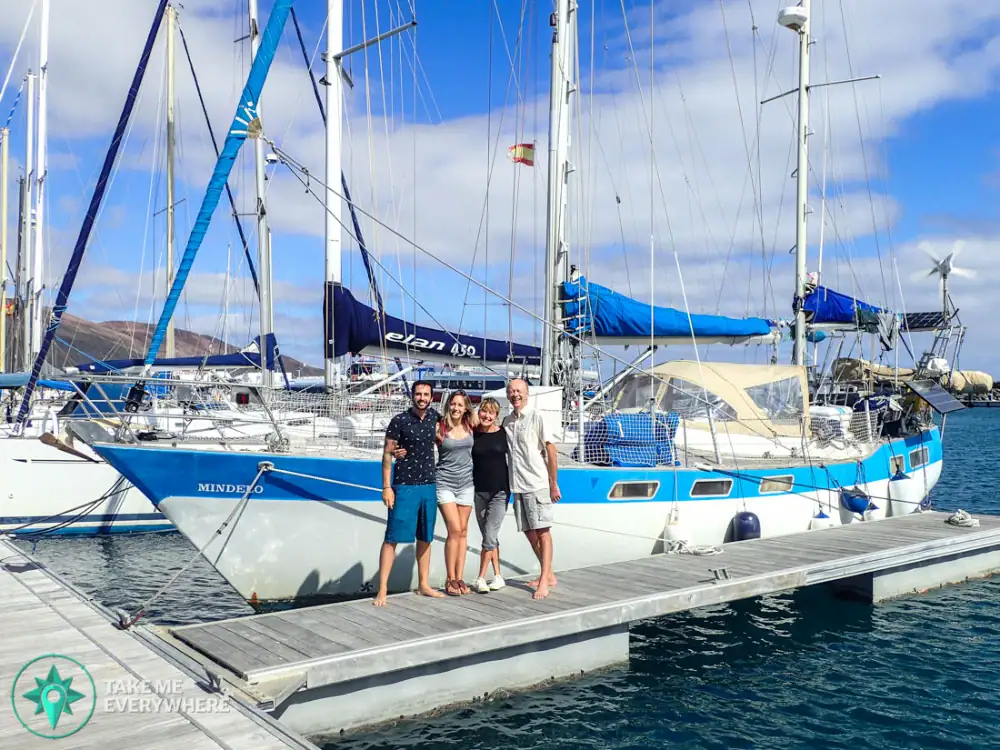
La Graciosa, Canary Islands — our first anchorage on Mindelo, with Patrice and Michèle, November 2015
The first open-water crossing hit us hard. A depression somewhere north of Europe pushed a sideways swell against the hull for eleven hours straight. Nathalia took the helm for five of those hours — no autopilot, it had broken — steering by hand through four-to-five metre waves. Vins contributed three involuntary tributes to the Atlantic and spent most of the passage horizontal. Wind peaked at 39.4 knots. We got to Gran Canaria exhausted, green, and quietly proud of ourselves.
El Hierro was the moment things clicked emotionally. At the westernmost tip of Europe — a lighthouse at the edge of a cliff, a cross planted there to mark the departure point for sailors heading to the New World — we stood and actually understood the size of what lay ahead. The ocean just goes. For weeks. There’s nothing.
« We impregnate ourselves with this powerful place, which reminds us that we too, soon, will have to cross this immense expanse of water. »— Vins, Punta Orchilla lighthouse, El Hierro, December 2015
After five and a half days at sea, we spotted Cape Verde through the morning haze. Nathalia’s shout of « TERRRRRRE! » woke the whole crew. We’d expected a quick stopover — we stayed 75 days.
Santo Antão and its extraordinary valley of Paul. The cliff-edge road called the « route de la corde. » A local woman who stopped mid-conversation to go home and fetch papayas from her garden for us. Boa Vista’s Saharan dunes drifting in on the trade winds. The tiny island of Maio, where we got marooned for two days by waves too big to launch the dinghy — until a fisherman named Pedro arrived in a wooden boat to ferry us ashore.
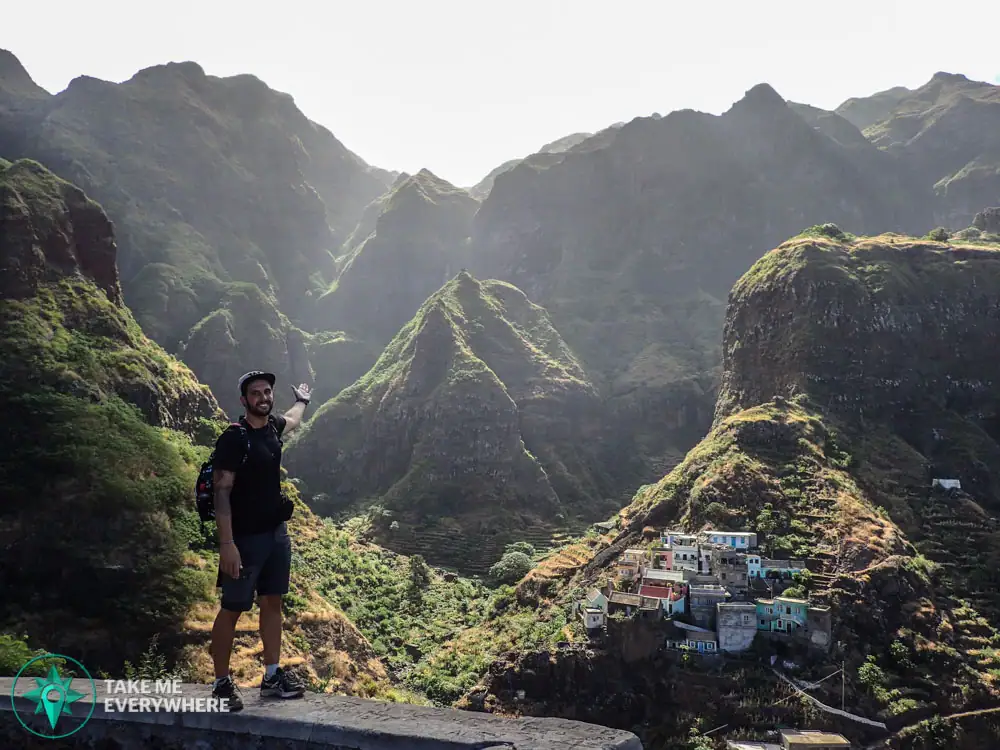
Santo Antão, Cape Verde — one of the most beautiful islands we’ve ever set foot on
In Mindelo harbour — our boat’s namesake city — Vins nearly lost the dinghy at night, drifting towards open sea with a dead engine in 40 km/h winds and a single paddle. A Cape Verdean fisherman pulled him back. We added « always check fuel before leaving at night » to the list of things we now know.
On the 10th of March 2016, we left Mindelo for the last time. This was it. Eleven and a half days. 1,330 nautical miles. Nothing in any direction but ocean.
The departure itself was a comedy. Strong gusts pulled the bow sideways before we’d even cleared the dock; our anchor snagged the neighbouring boat’s railing and snapped his solar panel. We left our card for the absent Breton skipper, untangled ourselves, and motored out of the bay at 2 pm — already laughing at ourselves.
I woke up at 7:40 to watch the sunrise. I was peeling an orange, throwing the peel into the sea. Then I saw a fin. Patrice said I was seeing things. I kept watching. There — another! I dropped my orange and ran to call Vins: DAAAAUPHINS! I grabbed the camera. They made an enormous leap in front of the bow. Incredible.
I found a long dead fish on the deck this morning. A strange Christmas gift from Poseidon — it looked like a sea-snake with large teeth. I finished one book and started another, read it almost in one sitting. Michèle and Nathalia made chocolate mousse and pineapple for the evening. Cooking on a boat that never stops moving is its own skill — bowls wedged in the sink, taking turns beating egg whites by hand. We ate Christmas dinner all together. Out here, that felt like everything.
The last night was the most dramatic. Forty nautical miles from Fernando de Noronha — our first Brazilian landfall — the engine stalled. Then stalled again. Then refused to start entirely. In the dark, with 20-knot headwinds, we raised the mainsail by hand and navigated the final miles under canvas alone. At 2:50 am, the anchor hit sand at 20 metres. We stood on deck in silence. Six thousand kilometres by sailboat. Done.
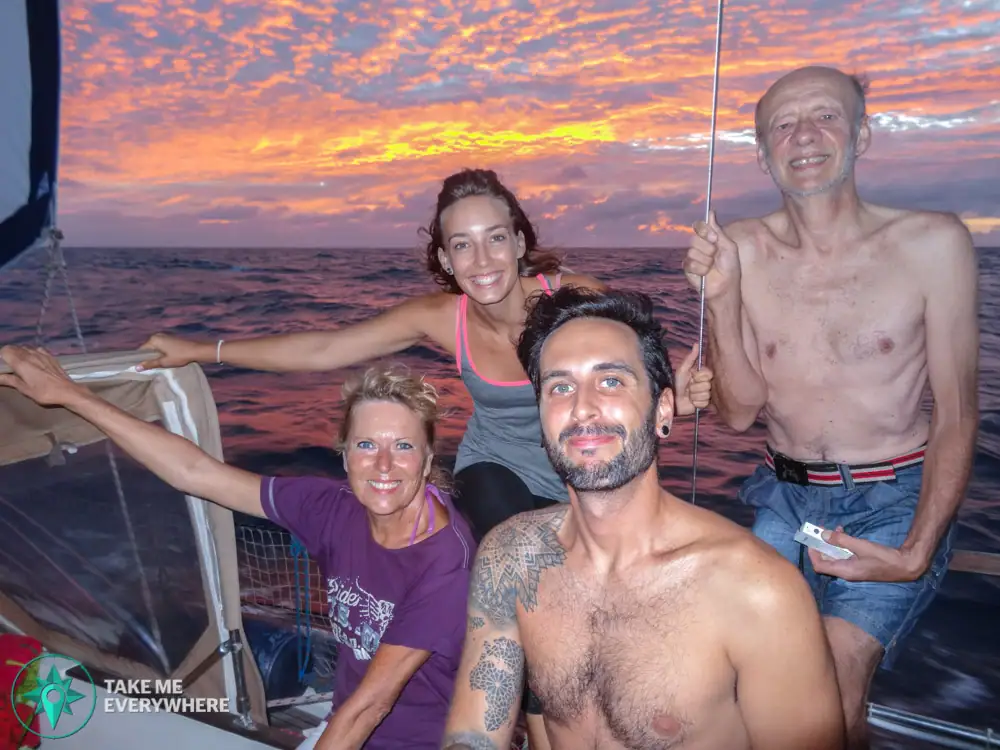
Our crew — 280 hours and 1,330 nautical miles after leaving Cape Verde, we made it to Brazil
« This incredible experience proved once again that ‘when you want to, you can’ — and that anything is possible if you believe it and stay motivated. »— Vins, Jacaré marina, Brazil, March 2016
Watch the Full Atlantic Crossing Film
55 minutes — from La Graciosa to Jacaré, via Cape Verde
🇧🇷 Backpacking Brazil
on Couchsurfing
On the 30th of March, we stepped off Mindelo’s deck for the last time, shouldered our backpacks, and started moving south. One rule: Couchsurfing only. No hostels, no hotels where we could avoid it. We wanted to see Brazil the way Brazilians actually live it — from the inside, at someone’s kitchen table.
Over three months, we stayed with eight different hosts. Each one changed something about how we understood the country.
A Mexican musician who’d moved to Brazil to study samba. We helped her make peanut butter to sell at the Recife market. She introduced us to tapioca crêpes — manioc flour pressed onto a dry pan, forming like magic. We ate them every day after that.
Nathalia woke up with swollen joints, rashes everywhere, a fever. Zika. We’d asked to stay three days. Raquel said: « You’re not leaving until you’re better. » We stayed seventeen. They’re still two of our closest friends from that whole adventure.
Six days, 15-20 kg packs, grotto camping, a flea that laid eggs under Vins’s toe. His shoes disintegrated mid-trek. Back in Ouro Preto, the toe was infected — emergency surgery, no waiting, no bill. The surgeon said one more day and the toe was gone. Cost: zero.
Our last host Flavia turned out to manage a boutique hotel above the Selarón Steps. She gave us a room anyway — free — and breakfast when other guests checked in. We got taken salsa dancing at midnight. We got brilliantly, happily lost.
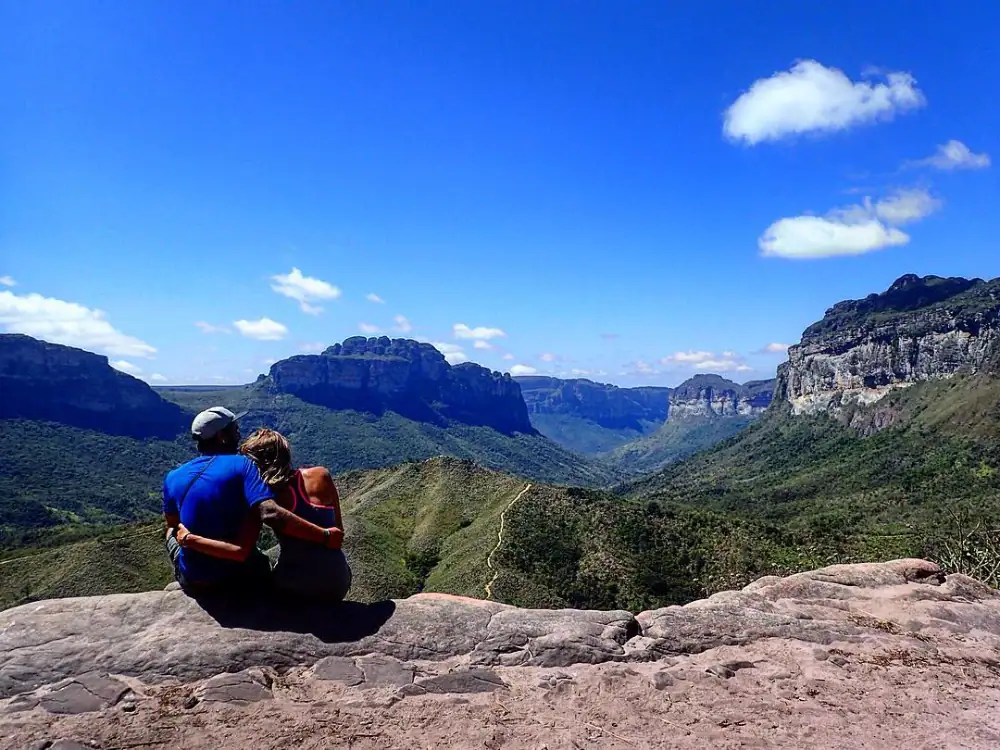
Vale do Pati, Chapada Diamantina — six days of jungle trekking that nearly cost Vins a toe
Brazil ended at Foz do Iguaçu. We stood on the viewing platform and got completely drenched by the spray of one of the world’s largest waterfalls — then crossed to Argentina for lunch. We ate empanadas, looked back at Brazil, and said goodbye to a country that had been chaotic, generous, terrifying, and beautiful in roughly equal measure.
Brazil Episodes
From Fernando de Noronha to Foz do Iguaçu


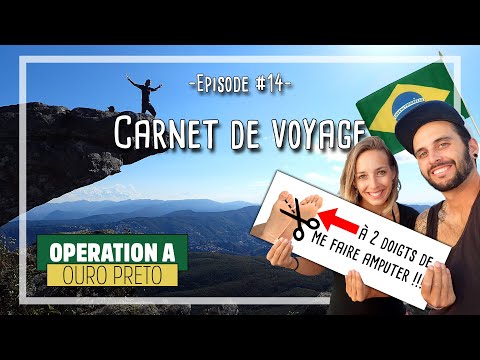


🇵🇪 Peru on Foot —
Salkantay to Machu Picchu
Peru was the reunion chapter. Our friend Fanny flew in from Switzerland to join us in Lima — and a few days later, our cycling friends Anysia and Alexi, who were crossing South America by tandem bicycle, resurfaced in Cusco. That’s the thing about slow travel: the world contracts. You keep bumping into the same people.
We started with the Misti. Because we saw this 5,825-metre volcano dominating the skyline above Arequipa and, well — it was there. We hired a guide named Inti (which means sun, which seemed like a good omen), climbed through the night, made camp at 4,600 metres, and summited at dawn. Fanny showed signs of altitude sickness around 4,800 metres, so Nathalia turned back with her while Vins pushed to the crater. It smelled strongly of sulphur and tasted like the best decision we’d made all week.
Then Cusco, and a disaster of hair. Vins lost a bet — we won’t say which kind — and agreed to have his hair bleached. The dye reacted catastrophically with his dark hair. He emerged not blond but a very confident shade of nuclear orange. Nathalia was asleep in the hostel. They kept it hidden until evening. She nearly had a cardiac arrest.
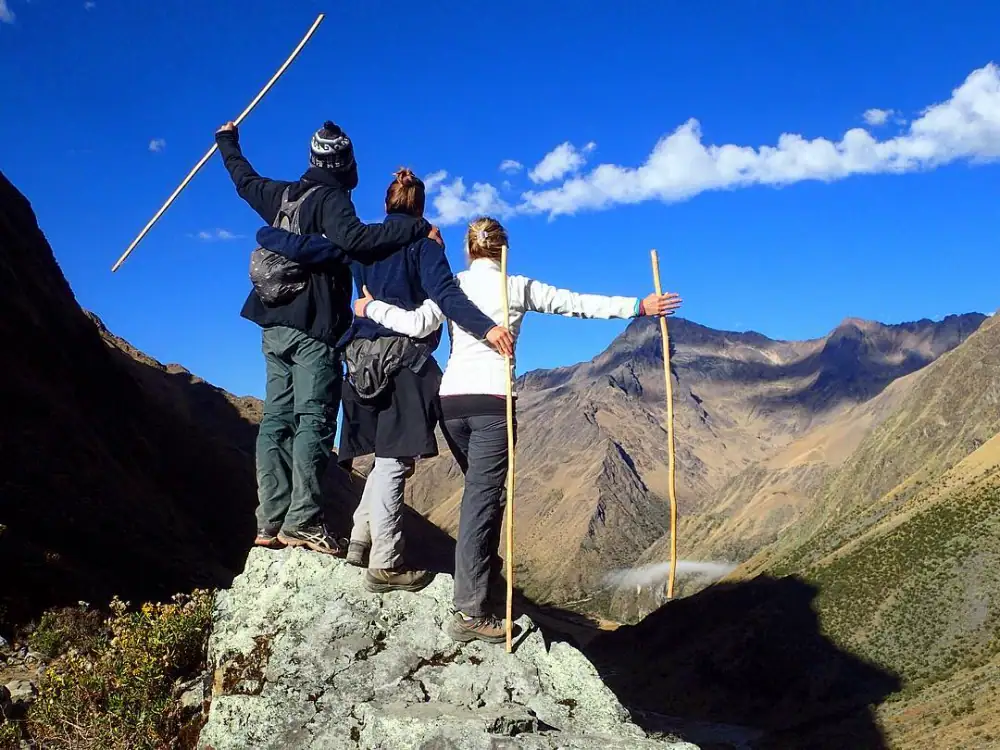
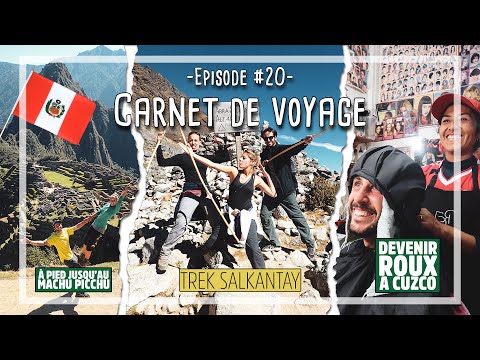
Salkantay Trail, Peru — 74 km over 4 days with our friend Fanny, to reach Machu Picchu on foot
The Salkantay Trek: four days, 74 kilometres, through landscape so varied it felt like four different countries. Day one: through the valley to the turquoise lagoon of Humantay at 4,200 metres. Day two: the pass at 4,650 metres, mules taking some of the weight, leaving before 5 am with coca-leaf tea still warm in our stomachs. Day three: descent into jungle, thermal springs, coffee picked and roasted by the family running the lodge. Day four: the old Inca trail to Aguas Calientes — and at the station, waiting: Nathalia’s parents, who had flown in from Switzerland.
We reached Machu Picchu at 4 am, climbing by torchlight before the first gate opened. The citadel appeared in grey morning light. We stood there for a while — the three of us — then kept climbing. Up to the Montana, another 650 metres above the ruins. From up there, you understand the scale of what the Incas built, and why nobody found it for five centuries.
« A new great dream accomplished. The realisation that when you truly want something, there is always a way — and above all, your own way of doing it. »— Nathalia, summit of Montana, Machu Picchu, June 2016
Peru Episodes
From Lima to Machu Picchu — desert, volcano, canyon, and the Salkantay Trail


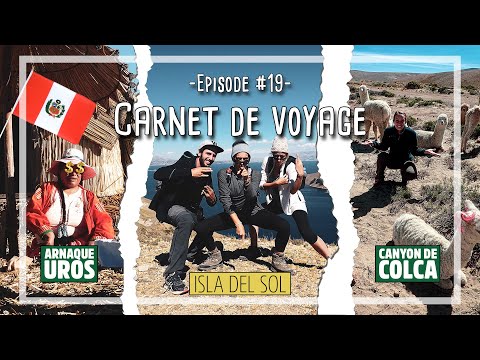
🇨🇴 Colombia —
The Lost City & 1,300 km by Tandem
Colombia meant family. Nathalia’s Colombian relatives had been waiting — and they don’t do things small. Nathalia’s uncle Juan organised the trek to the Ciudad Perdida, the Lost City, as a family expedition: nine people in single file through the jungle, cousins and friends and aunts, crossing rivers, sleeping in hammocks in the forest, passing through villages of the Kogis and Wiwa communities. One evening we spent two hours losing at dice to a teenage kid from the village who was absolutely thrilled about it. That kind of evening is worth more than any tourist site.
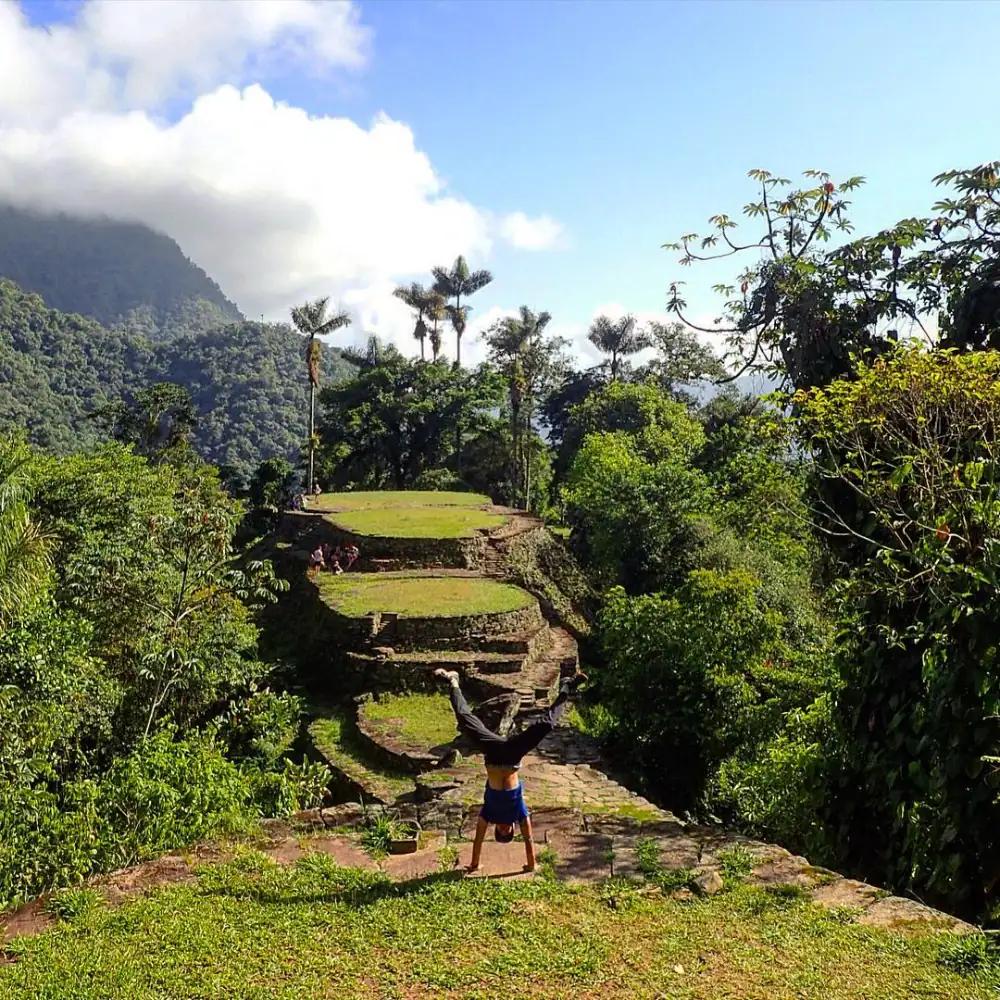
Ciudad Perdida, Colombia — 4 days in the Sierra Nevada jungle with the whole family
Back in Bogotá, we found a second-hand tandem for next to nothing, bought panniers and camping gear in the markets, cable-tied everything to a bus luggage hold, and headed south to Pasto to meet Anysia and Alexi. Four people, two tandems, the Colombian Andes ahead.
The first road was called El Trampolín de la Muerte — the Death Trampoline. A single-lane dirt track clinging to the side of a canyon, connecting Pasto to Mocoa through waterfalls and vertical drops. We climbed it in 6.5 hours at 5 km/h average. Alexi repaired Anysia’s rear wheel four times, improvising with a plastic fork, inner tube rubber and duct tape. He called it solved; she called it optimistic.
For 1,300 kilometres we pedalled north through the Andes: jungle heat in the Tatacoa desert, torrential rain for entire days at a stretch, a crossing of the Parque Nacional de Los Nevados at over 4,000 metres on a road that was more rocks than tarmac and destroyed two luggage racks and a derailleur. Colombian firefighters opened their barracks to us almost every night — a tradition for cyclists passing through that we found humbling every single time.
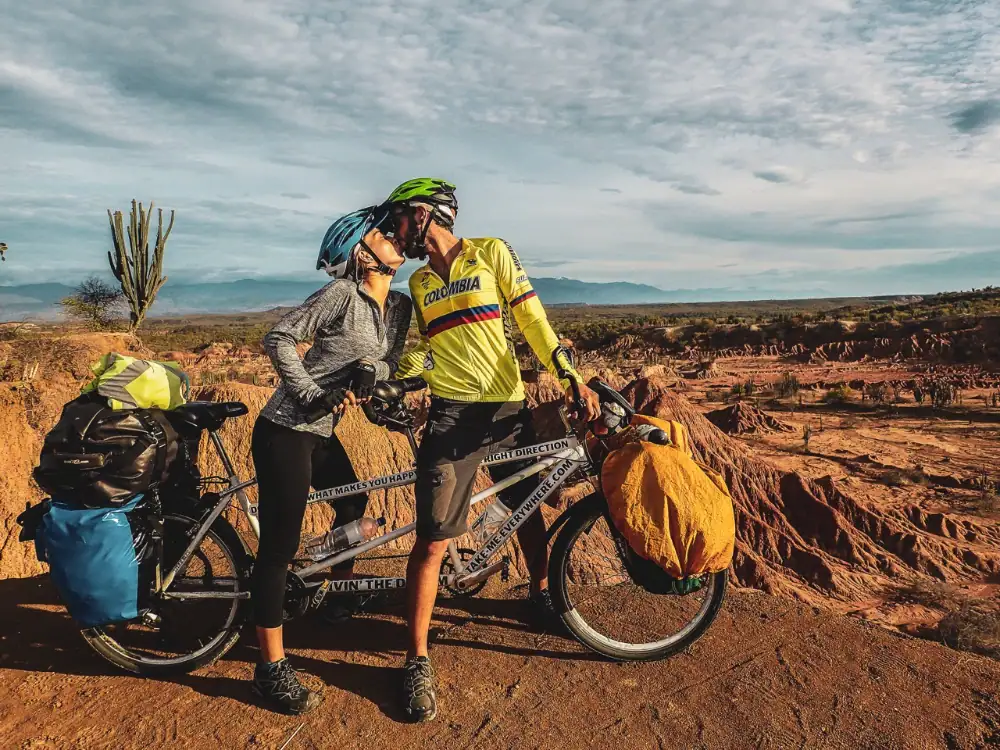
Tatacoa Desert, Colombia — 1,300 km by tandem through the Andes with Anysia and Alexi
Along the way: a woman named Gloria who invited us in off the road and introduced us to a village so unchanged by time the cowboys still rode horses to the bar. A coffee finca in the Zona Cafetera where we learned to play Tejo — the national game that involves throwing iron weights at explosive percussion caps embedded in clay. A birthday party for Nathalia in a rented farmhouse with a pool, springy stilts, and the kind of evening that feels completely unreal in the best possible way.
« The moments when we felt most free were the moments without any time constraints. So much learning in this magical journey. »— Vins, Bogotá, September 2016
Colombia — The Full 30-Minute Tandem Film
Plus the Ciudad Perdida jungle trek


« When nothing is planned, everything is possible. We were beginning to understand the full power of a flexible life — one where you can seize every opportunity that arrives. »
The Seed Was Planted
We landed back in Switzerland in September 2016. 533 days after leaving — 207 in India, 45 in the Canaries, 75 in Cape Verde, 76 in Brazil, 25 in Peru, 86 in Colombia. Nathalia needed her home, her family, stillness. We honoured that.
But something had shifted permanently, and we both knew it. The stretches when we’d felt most alive were the ones with no fixed schedule — when an unexpected fishing boat or a stranger’s invitation or a broken-down tandem wheel became the whole day. The freedom wasn’t about distance. It was about having no appointment with anywhere.
Five years later, in July 2021, we packed everything onto Falkor — our BMW F800 GS — and left again. No return ticket. No end date. No fixed route.
This journey was the rehearsal. The Falkor Journey is the real thing.
The Full 533-Day Route
79 steps — Canary Islands to Bogotá, documented on Polarsteps