We Were 20.
We Had 365 Days.
We Changed Forever.
It all started with a deal, the kind that launches a round-the-world trip at 20. A round-the-world ticket — the kind you buy from a travel agency that bundles flights across multiple continents at a fraction of the usual price. But deals come with rules: you have exactly 365 days, you can only move forward (no backtracking), and you must fly with their partner airlines. Break the rules, lose the deal.
We were 20. We had been together since we were 14, travelling since 15 — mostly weekend camping trips, a few budget inter-rail journeys across Europe. But this? This was different. This was a year. This was the world. We left Geneva on the 10th of January 2009, two Swiss kids with oversized backpacks and not nearly enough experience, fuelled entirely by curiosity and the quiet, furious need to see what was actually out there.
The plane wings were frozen on departure. We spent the first night in England, at the airline’s expense, waiting for our « metal bird » to de-ice. The journey had barely started and already the world was reminding us: nothing will go according to plan, and that’s exactly the point.
« 20 years old. Furiously wanting to discover the world. We got bitten by the travel bug. »— Our Polarsteps journal, January 2009
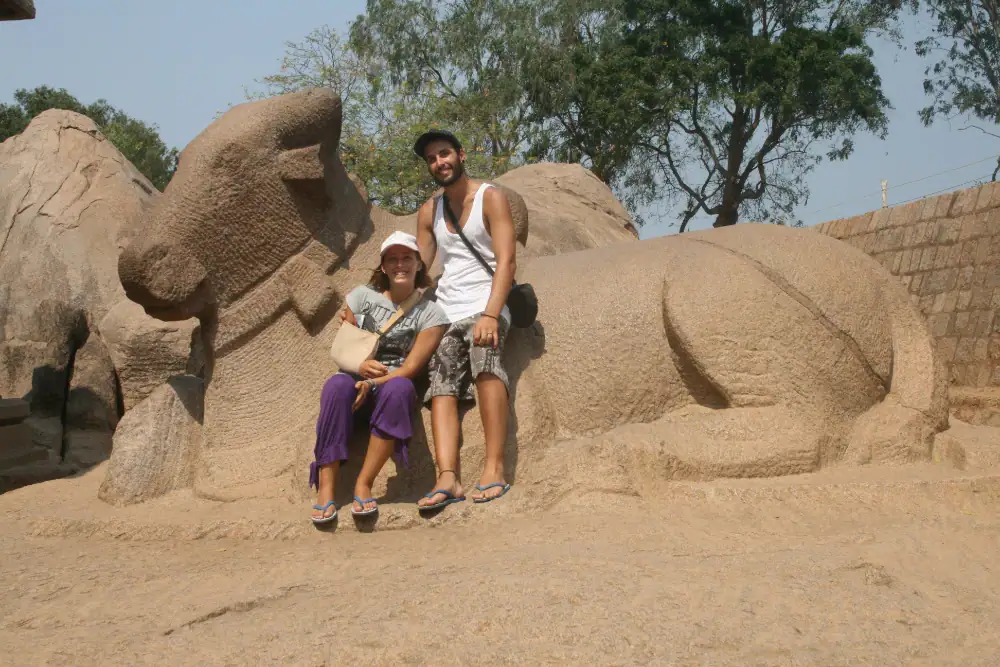
India, 2009 — the chaos was immediate, joyful, overwhelming.
Asia: Where the World Begins
We started in the deepest end of the pool: New Delhi. The chaos was immediate, joyful, overwhelming. We got pulled in every direction. Tuk-tuk drivers, street vendors, sacred cows, smells we had no name for. It was the best possible way to enter Asia — thrown in, no preparation, no buffer.
From Kashmir’s frozen houseboat villages to the tiger trails of Ranthambhore (where we heard the roar, saw the footprints, but never the tiger), from the Taj Mahal hidden in fog (« We were there — we just couldn’t see it ») to the pink walls of Jaipur, India consumed our first two months whole.
Sri Lanka followed: 19 days that felt like a gentler, quieter version of India. We climbed Adam’s Peak starting at midnight — what should take 3 hours took us 9. At the top, sunrise broke over a country still scarred by civil war in the north. We stayed in the south, surfed in Narigama, slept in a room so grotesque it made our Top 10 worst beds list on the spot (mosquitoes, ants, a man groaning outside the window all night — all for 4 Swiss francs).
18 days. A guide named Sakal. A porter named Tzandre, 18 years old. Himalayan peaks of 7,000 and 8,000 metres towering over us on every side. Children at tiny mountain villages asking for « namaste, mitay, school, pen ? » Pure air. Pure happiness.
Two days on a wooden junk boat drifting between limestone karsts. Kayaking through floating villages at dawn. The boat deck as a diving board at sunset. Meeting the same Canadian couple we’d later bump into again in Cambodia, Thailand, and New Zealand.
The largest religious building ever constructed — a city that once held a million people, when London was a village. We arrived before the crowds and lost ourselves in jungle ruins for hours, surrounded by monkeys and the sound of distant gongs.
An accidental paradise reached by a boat with two engines — both of which broke down mid-sea. Five hours on the open ocean before arriving at the most beautiful place we’d seen. We stayed four days. We should have stayed four weeks.
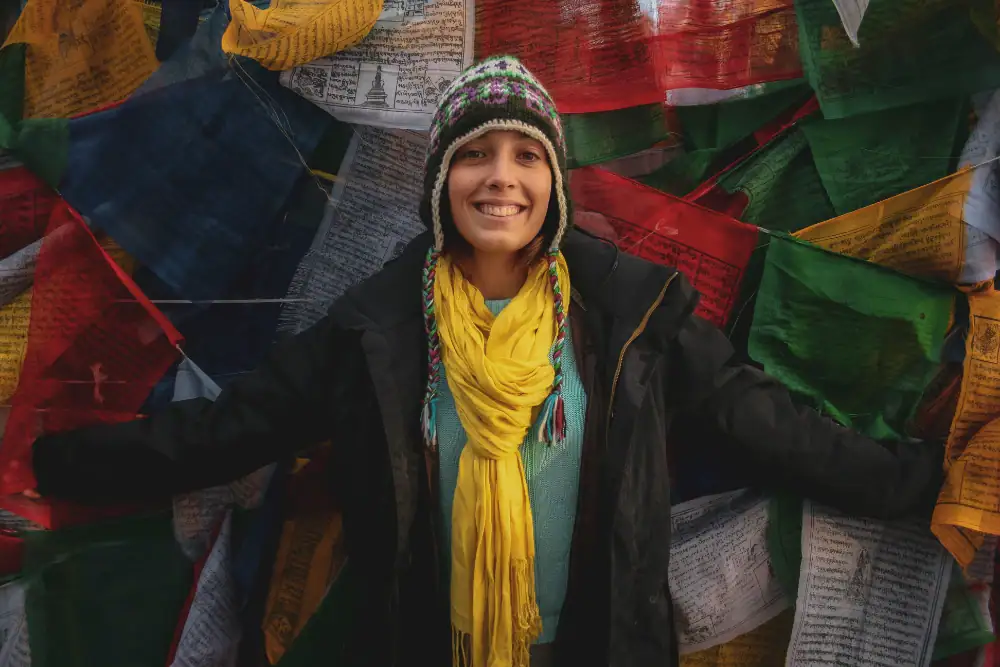
The 37-hour bus journey from Darjeeling to Kathmandu deserves its own chapter. Armed conflict had closed most roads in eastern Nepal. An Austrian traveller warned us: « Take the plane. » We got on the bus. We sat in the same seats for a day and a half, rationing cucumbers and water bought from children at the roadside, playing battleships to stay sane. We arrived in Kathmandu at 8am, immediately found our trekking organiser, and went shopping for snow gear — all in the same morning.
« Incredible. Every day, completely different landscapes and people. Finally, pure air, rice paddies as far as the eye could see. And above all — peace of mind. Happiness in its purest state. »— Vins, on the Annapurna Circuit, April 2009
South-East Asia arrived like a gear change: suddenly tourist infrastructure everywhere, menu cards in five languages, buses that ran on schedule. Vietnam, Cambodia, Laos, Thailand — each one distinct, each one memorable. In Laos, Vins ended up in hospital with a mysterious chest condition (he recovered). In Thailand, they only gave us 15-day visas at the land border — a policy targeting backpackers. Our solution: a « visa run » to Malaysia and back, same day, to reset the clock.
Indonesia was our last Asian chapter and perhaps our favourite. Bali with friends from Geneva, the erupting caldera of Mount Bromo, the gothic funeral rites of Toraja in Sulawesi, the Togian Islands barely on any map. After 7 months in Asia, we said goodbye to noodle soups with genuine grief.
Oceania: The Trip Inside the Trip
Sydney hit us like a bucket of cold water — literally. After 7 months of paying 3 to 10 Swiss francs per night, our cheapest option in the city centre was 60 dollars. We walked everywhere. The Opera House, the Botanical Gardens, The Rocks at sunset. Beautiful. Expensive. Worth every step.
But New Zealand was where something shifted. We made a deliberate choice: instead of trying to see the entire country in two weeks, we went to one small town — Ohakune, at the foot of an active volcano — rented a tiny apartment, and snowboarded every day for three weeks.
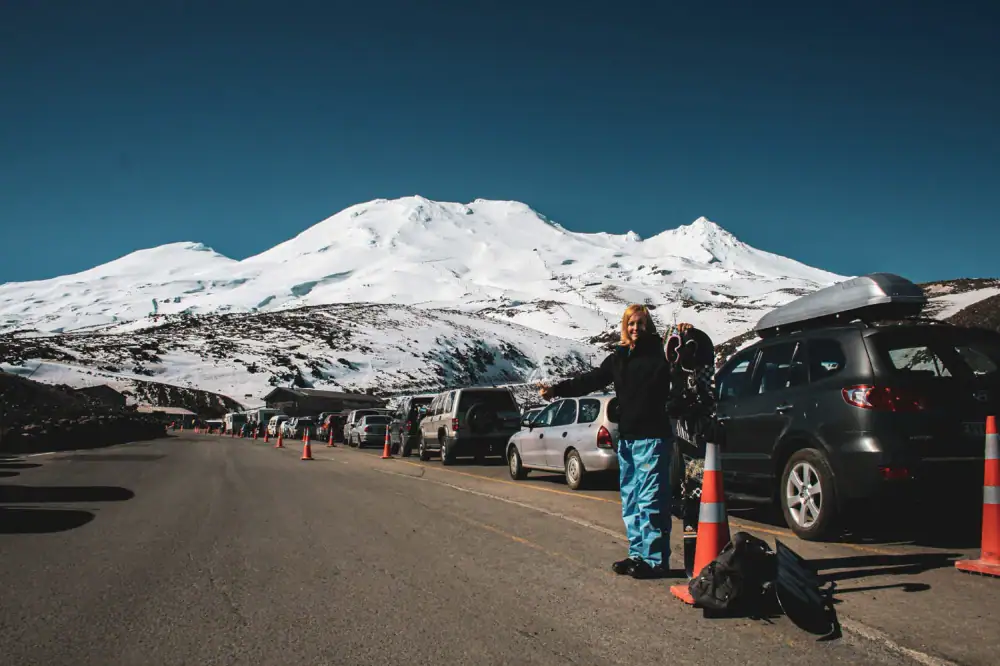
Mount Ruapehu, New Zealand — snowboarding a still-active volcano. August 2009.
We hitchhiked to the ski resort each morning. We cooked our own meals. We discovered our love of cooking improvised meals from whatever the local supermarket had. We celebrated Nathalia’s 22nd birthday in the snow, surrounded by people we’d just met, on the slopes of a volcano that was still technically active and occasionally releasing sulphurous fumes.
« We had tasted the pleasure of really discovering just one place in a country — without running everywhere. Just living there. It was wonderful too. »— Vins, leaving Auckland, September 2009
The Americas: South, Always South
Los Angeles for 48 hours: Six Flags rollercoasters, Venice Beach, and a limousine home because the hotel shuttle broke down. Nathalia had been learning Spanish since the start of the trip — now she was teaching Vins on the go as we crossed into Mexico.
Mexico was magnificent. Teotihuacan and its sun pyramid. The petrified waterfalls of Hierve el Agua in Oaxaca. The jungle ruins of Palenque. Then south along the Caribbean coast: Tulum, Chichén Itzá, the cenote labyrinths of the Yucatán. In Playa del Carmen we learned to scuba dive — first the PADI Open Water certification, then Advanced, because one discovery led to the next.
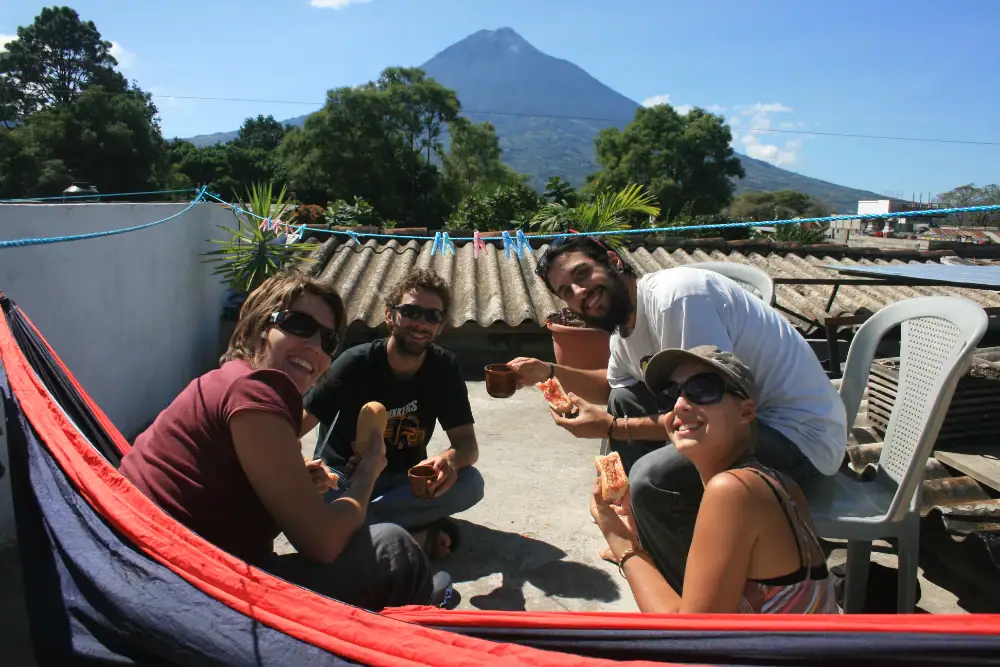
Central America — every country, a new world. Guatemala, October 2009.
Belize, Guatemala, Honduras, Nicaragua — each one a new world. In Guatemala, we spent 15 days with a rotating group of travellers we’d first met on a tiny Caribbean island, eating cheese fondue together in Antigua (« yes, at a Swiss restaurant in a colonial Guatemalan city »), climbing Volcán Pacaya and roasting marshmallows on lava flows, and swimming in the vivid green waters of Lago de Atitlán.
In Nicaragua, Vins sledged down a black volcano (Cerro Negro) on a wooden board, hit 41 km/h, and was disappointed he hadn’t beaten the men’s record of 82. The following day we trekked Volcán Telica at night, watched molten lava bubble 120 metres below us, slept under a tent as scorpions kept the guides company, and descended through jungle so thick it took machetes.
Panama brought family: Vins’s uncle Carlos, whom he’d never met. Family he had only heard about in stories, now real, laughing, loud, taking us on motorcross rides and to NOFX concerts. Then a flight to Bogotá, where Nathalia’s Colombian family — who hadn’t seen her in three years — threw parties spanning three generations and 27 people at a time. We ended the year on Christmas Eve, around a grandmother’s table, somewhere in the mountains of Armenia, Colombia.
Colombia, Christmas 2009 — Nathalia’s family, 27 people, three generations, one unforgettable table.
What a Round the World Trip at 20 Actually Teaches You
We came home in January 2010. Geneva was covered in snow. We had been 20 when we left; we were 21 now, and the distance between those two versions of ourselves felt enormous.
We had seen 24 countries in a single year. And somewhere in that relentless forward movement — dictated by our RTW ticket, always advancing, always checking new destinations off the list — we had found our paradox: the faster we moved, the more we craved stillness.
Three weeks in a tiny apartment in New Zealand, snowboarding a volcano and cooking bad pasta every evening, had felt more meaningful than crossing 5 countries in 10 days. The Togian Islands, stumbled upon by accident, had left a deeper mark than carefully planned UNESCO sites. The families we shared meals with in Hainan, the guide who carried our bags through the Himalayas, the travellers who became temporary family for weeks on end — these were the memories that lasted.
This trip didn’t just give us the travel bug. It gave us a philosophy. We had rushed through the world and learned, at high speed, that rushing was the one thing we didn’t want to do anymore. The next chapter would be different: slower, deeper, longer. Time as currency rather than kilometres as score.
Eleven years later, in July 2021, we left Switzerland again. This time: no return ticket, no fixed route, no time limit. Just Falkor — our BMW F800 GS — and the road ahead.
Everything started here, in 2009. We just didn’t know it yet.
Follow Our 2009 Route
128 steps across 24 countries — all documented on Polarsteps
Every step of this journey is documented on our Polarsteps profile — 368 days, 24 countries, in real time.